

RIDE SKILLS: BEYOND THE BIKE
Strategies for progression
Rory Bingham, Onward MTB Coaching
In this article, I’d like to describe a few strategies for learning and developing new skills.
Mainstream sports like rugby, golf and tennis have very clear coaching and skill development pathways, and it’s commonplace that players in these sports will be drilled over and over in the fundamentals of the sport.
That isn’t really the case with mountain biking. Seldom do we see riders specifically and deliberately practice, especially the basics. Most will just rely on increasing terrain difficulty or speed to feel challenged, but there are plenty of other ways to progress through working on fundamental skills.
Motivation and setting goals
How far you’ll make it through your skill acquisition depends on the strength of your motivation. Mindset is everything, and being truly committed to learning is an important first step in your journey.
Goal setting is key to providing structure and direction for your practice. It could be that you want to keep up with friends, you want to improve your track times, you want to ride a specific trail, or—one that I often come across—I want to ride safer and crash less. Writing down your goal makes it a physical reality and gives you a destination. The next step is figuring out how to reach that destination.

How we acquire and develop skills
Understanding how we learn can help make sense of what’s going on behind your own skill development. This helps to manage your expectations along the way and can help you to stay positive. When we’re motivated to learn something new, we do it in stages:
Stage 1: Cognitive
This is our first contact with the skill. We know what “good” looks like, but we don’t know how to find it or consistently feel it. Our physical movements will often be jerky, tentative or poorly coordinated. We’re “in our heads” a lot here, with lots of self-talk because we aren’t sure what we are doing right or wrong. Accurate analysis and quality feedback are essential to moving past this cognitive stage quickly.
Here’s the kicker—your success rate is going to be variable, and you can expect to fail at some point. This is normal. Focus on the positives and celebrate the successes to stick with it.
Stage 2: Associative
We’re now starting to refine our movements to create more consistent outcomes. We transition from using clunky thought processes towards quickly recalling memorised movements. We start to get an association of how much and when to move to manipulate the desired result. We’re not perfect here though, and the learning curve may undulate.
Stage 3: Autonomy
This is the territory that’s often described as the 10,000-rep stage or skill mastery. Here, we’re able to deploy the skill without conscious thought, especially the basics of it. We’re adaptable, can detect problems and make small corrective refinements with fluid, smooth movements. People here may be performing at an extremely high level with little visual effort.
There are three things I would like to highlight here:
- Trust the process. If you don’t get something first time, that’s normal—stay positive and patient.
- Mountain biking is difficult because we’re deploying multiple skills while adapting to what the terrain, conditions, and bike are doing. This is where drilling fundamentals into muscle memory comes to the fore.
- Failure and success are equally important to developing skills. Failure in mountain biking is more consequential than most others—this isn’t shanking a pitching wedge or dropping a pass. Managing risk is essential.
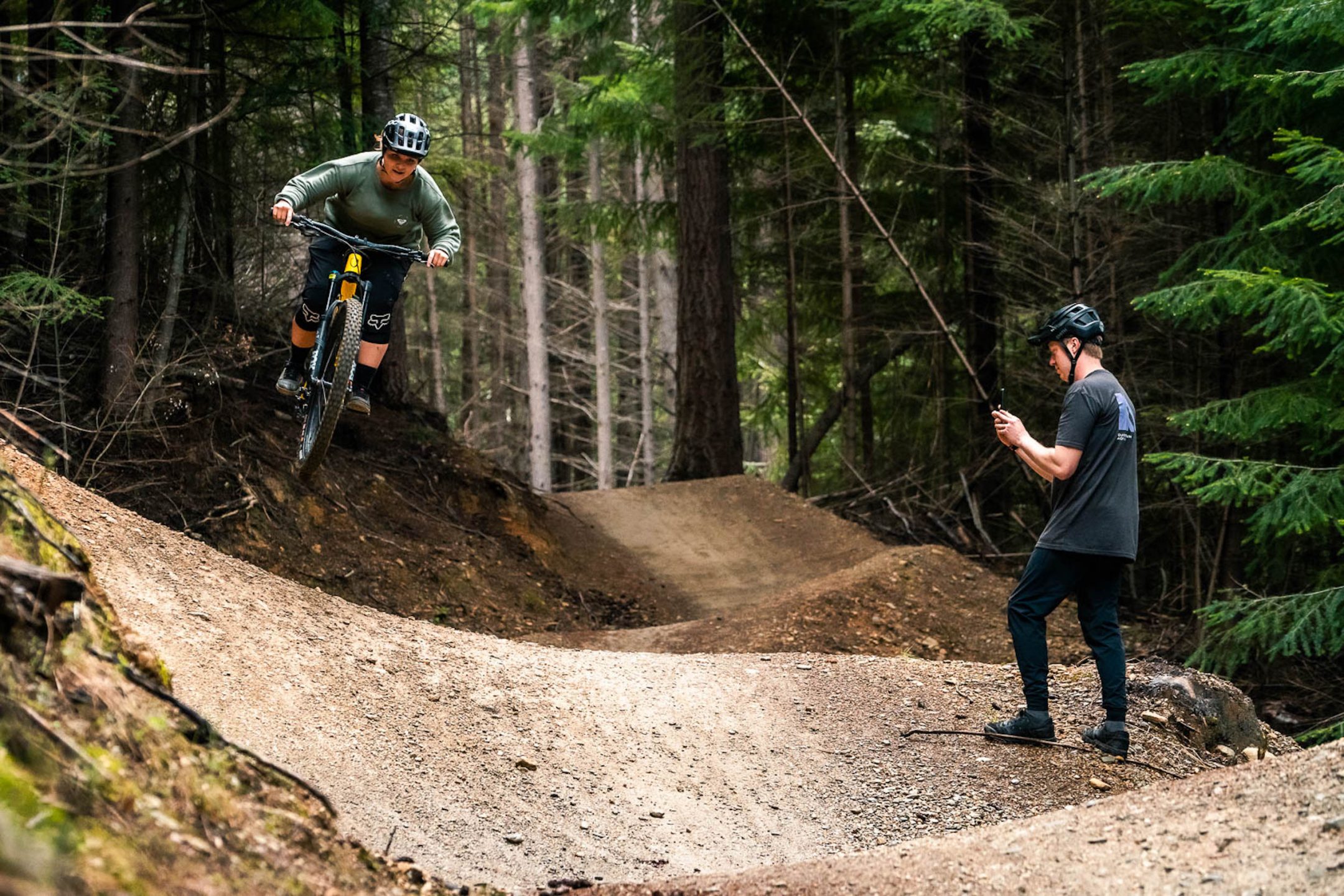
“Whatever you can manage, get out there and practise towards progress—it will all add up eventually.”
Practice and time
Were Amaury Pierron and Erice van Leuven once at the same stage as me? Yes, and their mastery of their skills comes back to two things—practice, and time.
It Takes Time
Skill mastery can take a lifetime of dedication. But for most of us, we have jobs, kids, social lives and various other things that restrict the time that we can invest. So, use your time to focus on progress, not perfection. You may never reach perfection, but you can progress – even if you don’t have much time.
The time it takes to master skills will differ from person to person, but the speed at which that happens often comes back to the quality of practice.
Whatever you can manage, get out there and practise towards progress—it will all add up eventually.
Creating Quality Practice
What’s the best way to practice skills? Set up your environment to create purpose to your practice by changing three challenge dials:
- Choose a technique—the simpler the better.
- On suitable terrain.
- At an appropriate speed.
These create purpose because they lead you to ride with intent, which is a new way of riding for most—it’s a fun, refreshing change to the same old “just riding”. They also help to keep things simple and reduce the chances of biting off more than you can chew.
It’s hard if you are trying to unlearn bad habits while simultaneously trying to acquire the correct ones. Start at the minimum setting for each dial to give your brain a chance to think. Then, as you develop, turn one dial at a time to increase the challenge to keep it engaging and explore further skill development.
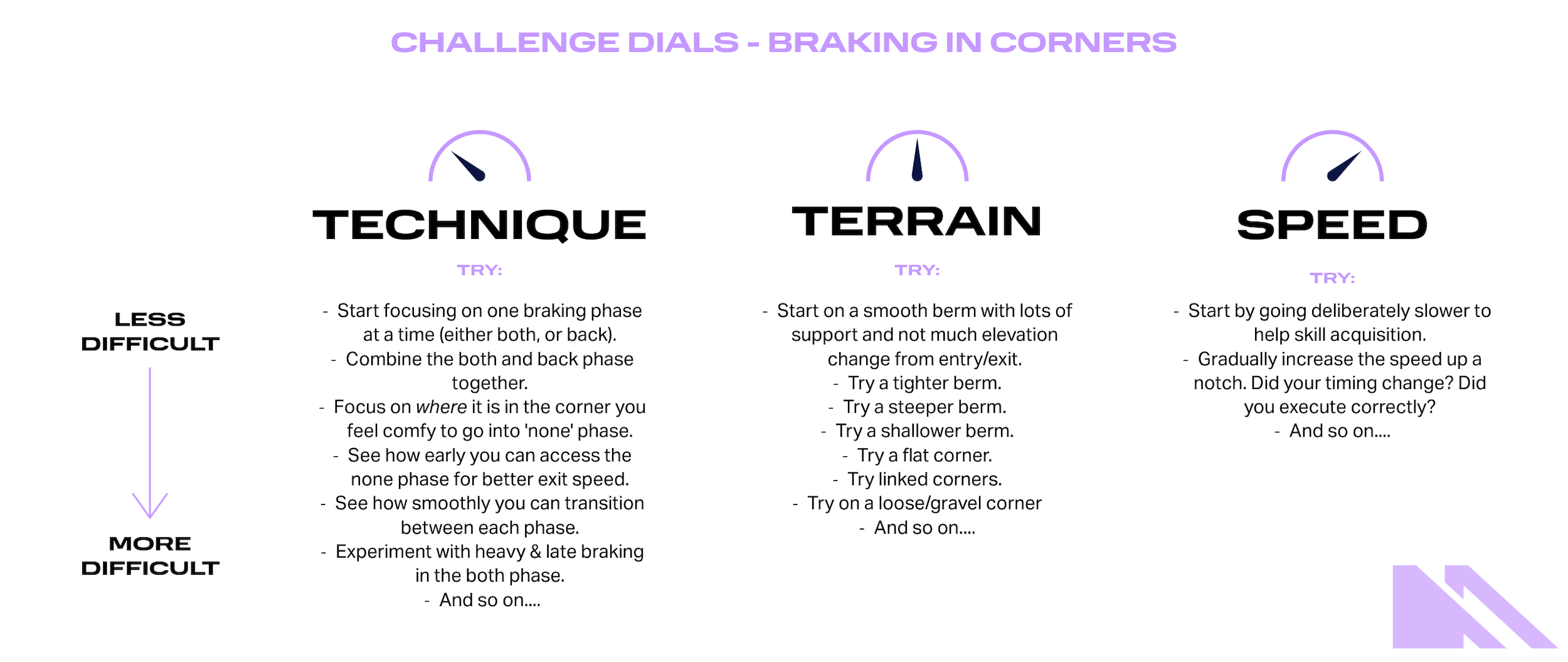
The Three Challenge Dials
Technique
I always encourage riders to place their emphasis on riding with quality technique first. Choosing the right technique to work on is where the role of a qualified skills coach is very valuable (and can save you time).
If in doubt, bring it back to basics—fundamental skills like body position (e.g. staying centred) and braking (e.g. using more front brake to stop skidding) are good places to focus. “The best do the basics better” is one of my favourite mantras.
Terrain
Choosing the right trail or section of trail is important. Riding above your skill level doesn’t necessarily improve your skills, often the opposite. You’ll improve much faster doing the right things on easier trails, than the wrong things on harder trails. You want to have the freedom to explore new ways of moving without having to process difficult terrain.
Try turning the terrain dial all the way back. So long as technique comes first, skill development can even come from a 5-minute session mucking around on the street. Once you’ve mastered the technique on easier terrain, practise deploying it on incrementally harder terrain.
My personal mantra (from the Professional Mountain Bike Instructors Association) is “maximum technique, minimum terrain”.
Speed
Slowing down is a great tactic—it gives you more time to execute movements and make a better mental connection with what you are doing. It also allows you to ride more relaxed, with better mobility. Gradually increase speed as the technique becomes more natural.
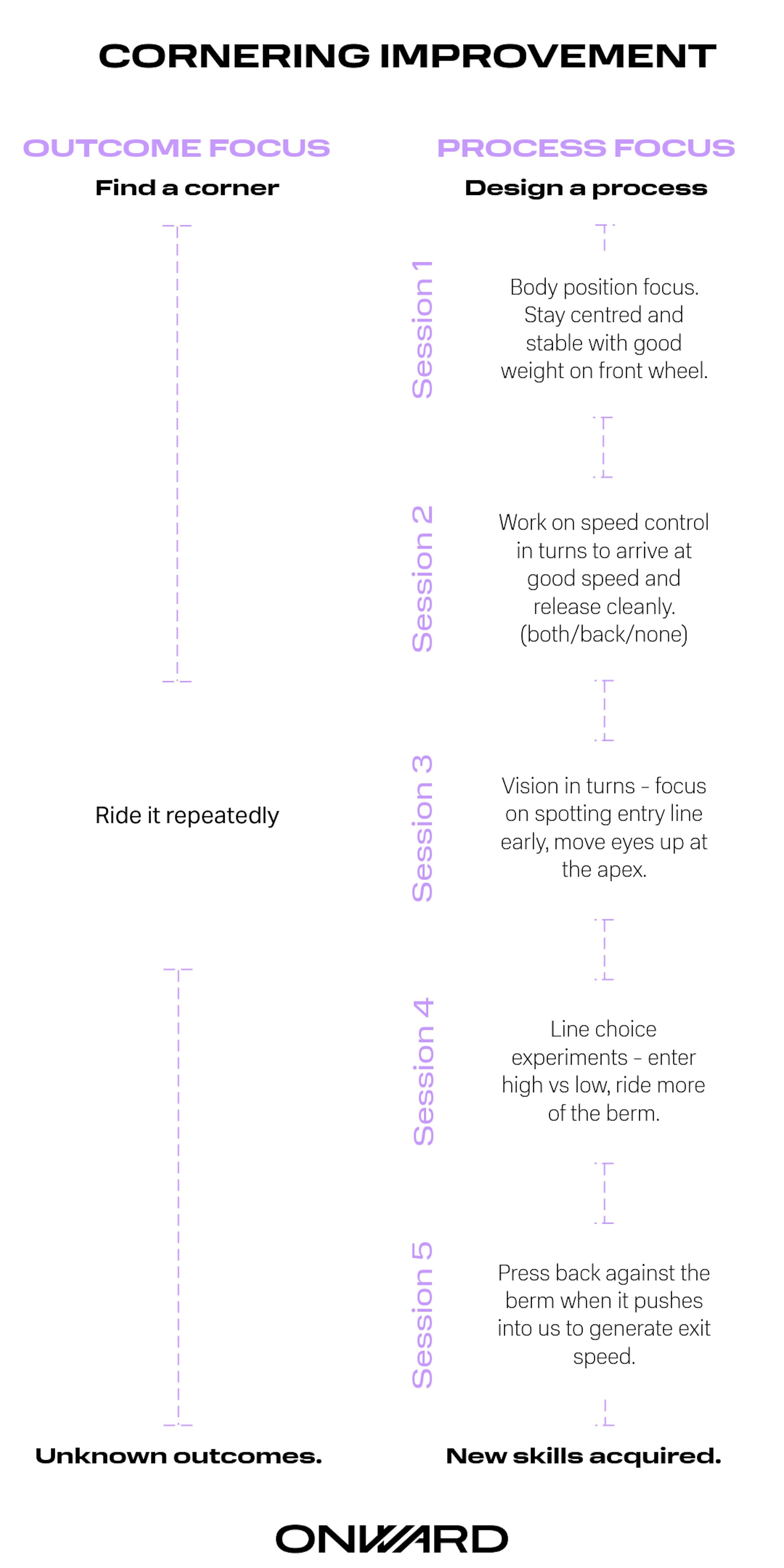
Process to progress
Okay, so skill development takes time, and we know how to practise a technique. Now how do we structure practice?
Break it down into a process. For an example, an outcome could be “I want to learn how to corner better”. Within each stage of the process, allow enough time to experiment with the challenge dials and session. The key is we’ve broken it down, focussed on one step at a time, and taken enough time at each stage to purposefully practise each step.
Enjoying success at each stage of your process builds confidence and awareness, and it’s proven to produce better results than fixating on the failures or the end-goal. It also helps move past the “cognitive stage”, where you have to consciously think about each movement.
Ticking off a series of small goals means you have more chance of sticking with your commitment to improve and developing your skills into an “association stage”. You’ve set yourself up for success, rather than blindly aiming for an outcome.
Think of any process as a pathway to achieving an outcome. Get it right and you’ll unlock tangible progression that you can really feel.
Key points:
- Focus on one thing at a time. Keep it simple.
- Spend enough time practising a technique before moving on.
- Get feedback from a coach, a friend, or a self-filmed video, whatever; but remember that once you’re past that initial cognitive stage, good technique feels good.

Track the process
Feedback from an expert coach is invaluable. There are ways to self-analyse, but just be clear on what your ideal image is. Watching professional athletes is an excellent way to visualise what “good” looks like, but it’s easy to miss important cues. Take the above video for example—can you identify the good from the bad?
Be kind to yourself along the way and stay positive. We all have times where we’re feeling it and other times where it’s just not clicking. Accept this as part of the process and understand it’s perfectly normal. Remember that failure is part of learning, view it as an opportunity to improve. One of my mentors, Ross Dunlop, once said something along the lines of “that person is so good because they were prepared to fail more than others”.
On that note, don’t be afraid to take a step back if you need to. Assess where you are at and focus your time where you’re going to get the most return.
Go Learn Something New!
There we have it, some strategies for learning something new on the bike.
Committing to improvement is an admirable thing to do because it’s vulnerable place. It’s upsetting the status quo of your riding and being prepared to take a step back to move several steps forward can be daunting.
However, if you can commit some time to purposefully practise within a carefully structured process, you’ll be well on your way to riding better and having more fun on your bike. Happy trails!
This article contains some material and ideas from the Professional Mountain Bike Instructors Association (PMBIA). It is written to unpack some of the riding theory behind improving your skill set on the bike. These articles are in no way ‘absolute’. Our sport is dynamic and ever changing, so there will always be exceptions to some of these general concepts.
I’m Rory, head coach and owner of Onward MTB Coaching. I’ve been coaching for 8 years and a passionate rider/massive bike nerd for 20+ years. Based in Queenstown, we strive to offer the finest coaching experience in New Zealand. We’re proud to work with elite to beginner riders of all ages to improve their riding to meet their goals. I am sponsored by POC Sports and RAAW Mountain Bikes.