
RIDE SKILLS: TIGHT SWITCHBACKS
Rory Bingham, Onward MTB Coaching
We’re going to look at an aspect of technical climbing in this article – uphill tight switchbacks.
It may not be the primary reason for many to go riding, but getting better at climbing has loads of benefits. It’s frustrating when you have to start again after coming unstuck on a tricky section of a climb (especially with an elevated heart rate). With the advent of e-bikes, climbing has become a more enjoyable part of riding for many, so why not get better at it?
Improving your success rate on tricky uphill sections will unlock more flow to your riding, improve your efficiency and brings about a refreshing new challenge. It’s amazing how many skills you can develop on a tight, uphill corner, too—line choice and speed control are just some that we’ll look at.
Ultimately, you’ll get to the top of the hill quicker and with more energy for when gravity takes over.

Line choice: Create some room
Firstly, where you place your tyres is crucial for success.
Take the above pictures for a couple of hard examples (they are steep, I promise!) on grade 2 and grade 3 climbs (as of today’s date). The red zones are the realistic boundaries, the green lines are an ideal path for your front tyre, and the yellow arrows indicate the room that we’ve created for ourselves.
Entering wide early with your front wheel will:
- Create time and space for you to co-ordinate your movements and search ahead.
- Allow more space for your back wheel to lag behind the front wheel on a safer line (at slow speeds they won’t travel on the same path).
- Spread out your turning movements, so you can do more of your turning earlier. In the first example, there’s a choke point late in the turn, so straightening up as you pass through here is key.
The outcome is that there is less chance of stalling out mid turn because you’ve manufactured a larger turn radius. This also spreads out the gradient across the turn (avoiding late pinches), so you’ll be able to maintain smoother power through the pedals.
Older trail design parameters aren’t exactly friendly to those of us with big bikes with long wheelbases, so this becomes more important now than ever.

Speed Control
Just like a car, the slower you go the tighter you can turn.
Finding the ideal speed will depend on how tight you need to turn. In the video above, my speed intentionally fluctuates through the turn—it gets slower when I need to turn more to avoid the bank, but then speeds up as I straighten up out of the turn. Learning to adjust your speed is a valuable tactic to have.
Maintain, or increase your speed by pedalling, either full pedal strokes or a ratcheting movement for fine speed adjustments. Gear choice dictates how much speed is added, so its key to change gears before the turn. E-bike-power modes are important too—torque-sensitive modes (Bosch’s E-MTB mode, for example) tend to produce the best results for predictable power delivery.
If needed, reduce your speed by dragging the rear brake. That will keep your front wheel free to track the ground and won’t upset your stability. For e-bikes, this is a good tactic to mitigate any unwanted surging through tight turns.
When adjusting speed, try to do it smoothly because this makes it easier to balance.
The bottom line? Speed control links in nicely with line choice—if you’ve created room with your line, go a little slower to make the most out of it.
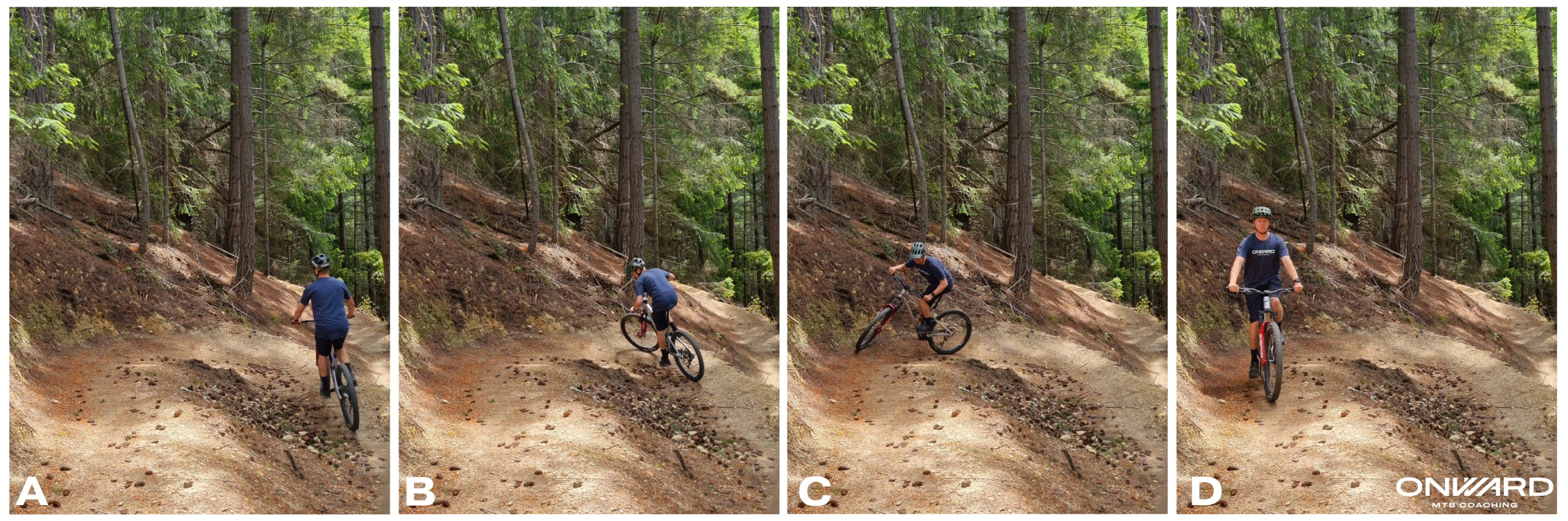
Body Position for Stability and Balance
To remain stable and be able to balance better, there are a few things we can do with our body:
- Keep the front wheel weighted. This keeps the front tyre tracking your chosen line. Drop your chest a little closer to the handlebars to achieve this. Your mass will then stay more central, improving your stability through the turn.
- If you’ve found more stability in your position, the next step is to relax. Loosening up with your upper body allows your muscles freedom to move. Stay mobile so you can balance when you need to. This is crucial for success when things get really slow and tight. It can be a bit nerve-wracking slowly teetering along but do your best to become comfortable with this.
- Look through the turn with your shoulders. Imagine your eyeballs are on your sternum, and you need to twist it to see ahead. This will encourage the bike to follow your lead through the turn.
The picture sequence above shows how I adjust my position throughout a slow tight turn. On entry (A) and exit (D), I am quite upright in my usual climbing position. I move lower when needed (B), to engage my tyres throughout the turn (C).
Purposeful practice
This one is so easy to practice at home. This simple drill has incredible overlapping benefits in developing your balance, stability and co-ordination in your riding. Set up some markers in a figure of 8 and practice riding around them, focusing on your line choice, speed and body position to achieve controlled, tight turns.
Further experiments to try:
- Change direction of travel.
- Create boundaries around the two markers. Adjust these boundaries to challenge your line choice e.g. experiment with wider/narrower boundaries on entry/exit.
- Change gears and find which one suits different speeds.
- Try ratcheting your cranks for fine speed control.
- Add gradient—do it uphill and downhill to challenge speed control.
- Slow race (without track stands). Perfect if you have some competitive mates!
I’m Rory, head coach and owner of Onward MTB Coaching. I’ve been coaching for 8 years and a passionate rider/massive bike nerd for 20+ years. Based in Queenstown, we strive to offer the finest coaching experience in New Zealand. We’re proud to work with elite to beginner riders of all ages to improve their riding to meet their goals. I am sponsored by POC Sports and RAAW Mountain Bikes.