

RAD RIGS
Chris Sinclair’s Brooklyn Machine Works Racelink
Words Justin Henehan
Images Sam Minnell
From Spoke Magazine issue 86
There are iconic bikes. There are rare bikes. And then there are bikes that define an entire zeitgeist.
The Brooklyn Machine Works Racelink emerged during a truly mad phase for mountain bikes. Bikes had travel measured in feet, not inches, and bottom brackets were sky-high. Josh Bender was sending his Karpiel Armageddon off cliffs.
It was an era that produced Marzocchi’s Monster-T, Nokian’s 24-inch Gazzalodi tyres, and Scott’s ludicrously large Octane DH saddle. It was an era of big everything: big bikes, big hucks, and even bigger crashes. An era where the bikes where simply set up to protect their fragile, meaty, “no regerts” cargo from the rapidly approaching ground.
The Racelink stood out because it was a race bike, and Brooklyn Machine Works’ tilt at a machine built for speed. It was ahead of its time in more ways than one.
My earliest memories of Brooklyn Machine Works are hazy magazine recollections of riders sending features in New York’s Central Park. That 341ha slice of paradise in urban Manhattan was where Brooklyn Machine Works ultimately had its genesis, when Joe Avedisian met champion trials rider, Chris “Doc” Bourdreaux. They became fast friends, and the pair would meet regularly for photo shoots in the park.
Their partnership produced a series of amazing, era-defining bikes, from 1997’s brutal, 70lb, jackshaft-driven, high-pivot Supertrucker, to the Masterplan, the TMX, and the Big Link, the latter being Brooklyn Machine Works’ first iteration of the motocross-inspired moto-link.
All of the ingredients were there, and each bike became more refined until the evolution reached its zenith with the Racelink, a bike built for Joe to race.


On the other side of the Atlantic in Britain, an expat Kiwi, Chris Sinclair, was flipping through a magazine when he noticed a picture of a mountain bike the likes of which he’d never seen before. Interest piqued, he showed a friend, and they both nodded their approval. That photo of Brooklyn Machine Works’ TMX made a deep impression.
Chris dived head first into the Brooklyn Machine Works rabbit hole. And the further down he went, the more intrigued he became.
“I guess when you get focused on anything, something that starts off looking weird and odd, maybe a little bit not-really-your-vibe, after researching for a while and immersing yourself down that rabbit hole, it starts to look cooler and cooler. I think I became obsessed.”
He decided he had to have one, so he got in touch with Joe and was surprised to learn there was a dealer in Britain. Kind of.
Chris was put in touch with Jed “the Head”—a window washer and passionate former street rider. He had a Facebook page, but otherwise there was nothing official, Chris says.
“I asked him how I could get hold of one of these things. He said, ‘well, you pay me a deposit’.”
“I think I became obsessed.”
Chris Sinclair
The price was £3300 for the frame only, an astonishing of money in 2005, Chris says. One pound Stirling bought about three New Zealand dollars back then, putting the price at about NZ$9900.
“I basically dropped a pile of cash into an envelope and gave it to this window cleaner. In fact, it was worse than that – I had to drop it into his account. I was going, ‘oh my God, am I going to be ripped off here? I’ve just put a thousand pounds into this stranger’s bank account.’ But he turned out to be a very, very lovely, generous spirit who looked after people. I don’t even know his surname.”
It was a huck of faith. Now all that was left to do was wait … and hope.

Eventually, it arrived. Giddy with excitement Chris pulled the ruby red frame out of its box and got to work building it.
“When it arrived, someone took a picture of it for me, and I was the happiest kid in town. I was 35 and I felt like I was 15. At first, I was a little bit shocked, because the frame was about 19lb on its own,” he laughs. “This was a burly bit of kit, but it was beautiful.”
He had some Marzocchi 888 RC3 WC forks – another “Jed the Head” deal – but because the frame was so eye-wateringly expensive, he had to scrounge around for cheap parts to finish the build. It didn’t matter to Chris, though; he had his dream bike, and he rode it everywhere.
“I’d commute 10 miles each way to and from work on it, just because I was so besotted with it. There were some jump tracks near home, and I’d get up at 6am, pedal round to them and push up and do six runs. That was about four miles each way on a 40-something pound downhill bike.”
“I’d commute 10 miles each way to and from work on it, just because I was so besotted with it.”
Chris Sinclair
Chris bounced back and forth between New Zealand and Britain over the following years, but the Racelink always went with him. Chris and his Racelink eventually settled back into life and riding in Christchurch.
“I raced it a few times. In 2012 I won a DH Open on Lava Flow in the Masters category. I raced at the Remarkables with the late Kelly McGarry. He was in our category, I think. Because the bike was so reliable, I’d often do quite well results-wise because I’d finish when faster people might not.”
Then Chris brought a Zerode Taniwha, and the Racelink ended up in limbo. It slipped further into the background when Zerode co-founder, Rob Metz, sold him a G2.5 frame. The Racelink’s parts were poached and what was left ended up in a box at Rufus Wenlock’s shop, Back Alley Bikes.
“I kept thinking ‘I have to do something about it’, but there were so many little problems to solve. I needed all sorts of bits, and I didn’t know where the bearings had gone. And what will I do about the Avalanche shock? That’s got to go to the US.”
Then two things happened that relit the fire. First, someone posted a Facebook ad looking for a Brooklyn Machine Works frame.
“I was offered €4500 ($7600) as it was, in bits, with God-knows what parts. And I did a little bit of searching and I found one that sold on eBay for US$15,000 ($26,000).”
Then, in 2022, Manitou released the Dorado Pro. As soon as Chris saw it, he knew it had to go on the Racelink: “it would be a homage to the old-style builds that people who raced Brooklyns had, with the old MRD carbon Dorado.”
Chris didn’t muck around. He put in an order with Dougal Hiscock at Shockcraft, and asked Rufus at Back Alley to throw the bike together with whatever was left in the box.

“I went out and rode it, and I was like, ‘oh my God this thing is so quick’.”
Chris Sinclair
“I went out and rode it, and I was like, ‘oh my God this thing is so quick’. I was on 26-inch wheels, rolling behind guys on 29-inch downhill bikes and having to brake really hard not to run into them. When I got in front of them, it just took off like I was pedaling, or I was on an e-bike or something. It was just so much fun.”
The die was cast. Rufus at Back Alley didn’t have time to do the full restoration, so Chris tracked down Josh Boot of Racebikes in Christchurch, who incredibly had all the spares.
“I said, ‘do you want to build this?’ and he said, ‘I absolutely want to build your bike’.
“I must’ve been a real pain for Josh, because it was a Wednesday, and I wanted to christen it that evening on a night ride. I told Josh, ‘sorry you’re not going to like me, but I’m coming in and sitting on your shoulder until this thing is done. I’m riding it tonight’.”
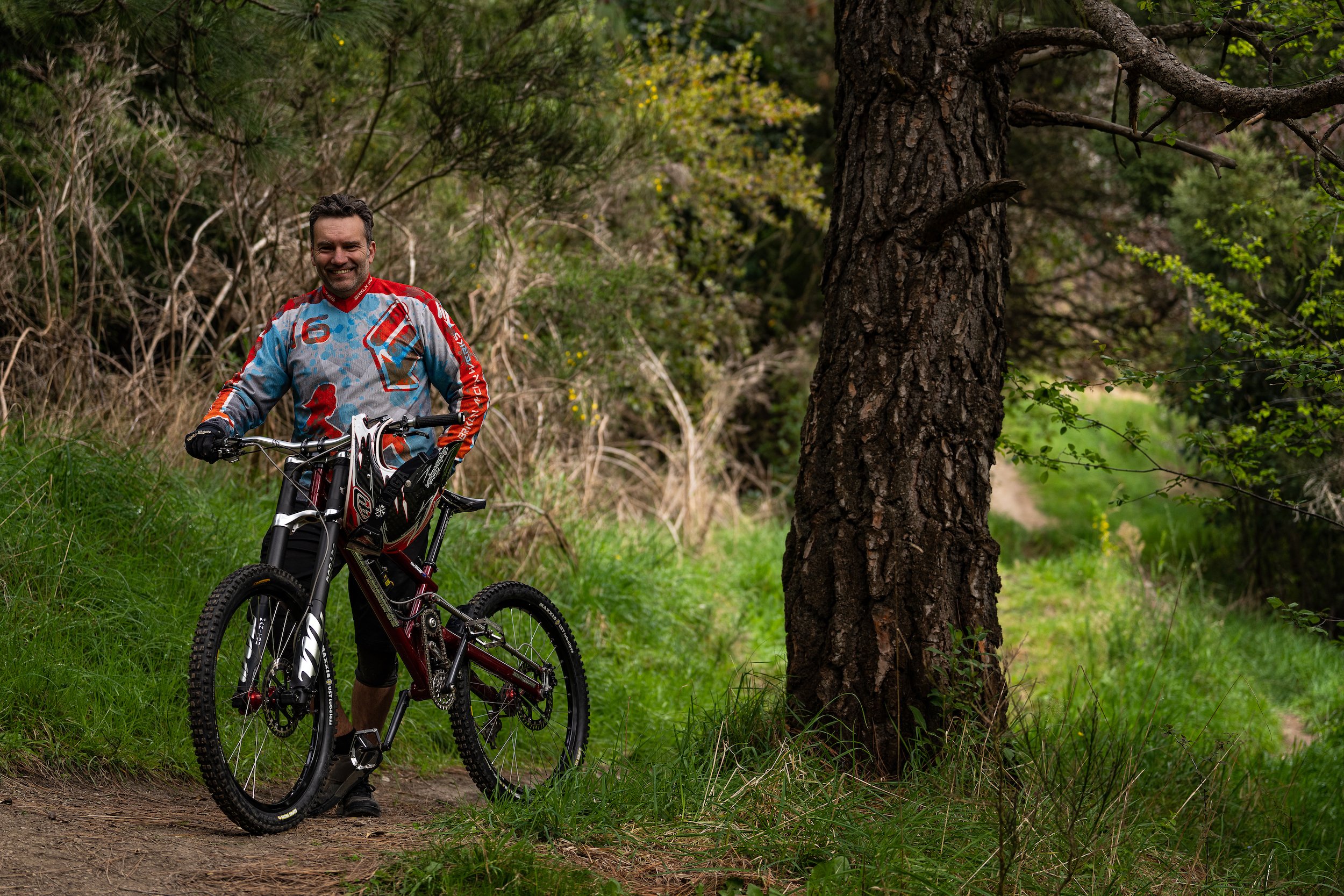

There are still a few problems still to solve. The Avalanche shock needs a service, but Chris doesn’t want to risk sending it to the United States.
“What would I do if it goes missing? Nothing else fits the bike. I think Dougal at Shockcraft has done some Avalanche stuff before, so he’ll deal with Avalanche and get all the bits he needs and just do it in New Zealand. So that’s my next conversation with him.”
There are also a few small bits Chris doesn’t have or hasn’t been able to replace. Part of the original chain guide, a folded piece of box section plastic, is one of them. He also wants to track down an original Brooklyn Machine Works chain guide. But the bike is ridable, and Chris is riding it.


It’s no show pony, he says.
“My friends assumed I was going to stick it on the wall. I said ‘No, I’m going to ride it. I’m going to ride it!’ I might save it for sunny days, but I’m going to definitely ride it.”
Chris isn’t certain, but he thinks his might be the only Racelink still in the hands of its original owner.
“They’re bought and sold and refurbished and there are a lot of amazing, cool builds done on them. But there’s no-one else who can say, ‘I’m the original owner of Racelink 108.’ And that’s my number: 108.”
Do you have a Rad Rig to share? Email editor@spokemagazine with your submission. If we’re into it, we’ll publish it.